Pottery Classes vs Self-Teaching: What Works Best for UK Beginners?
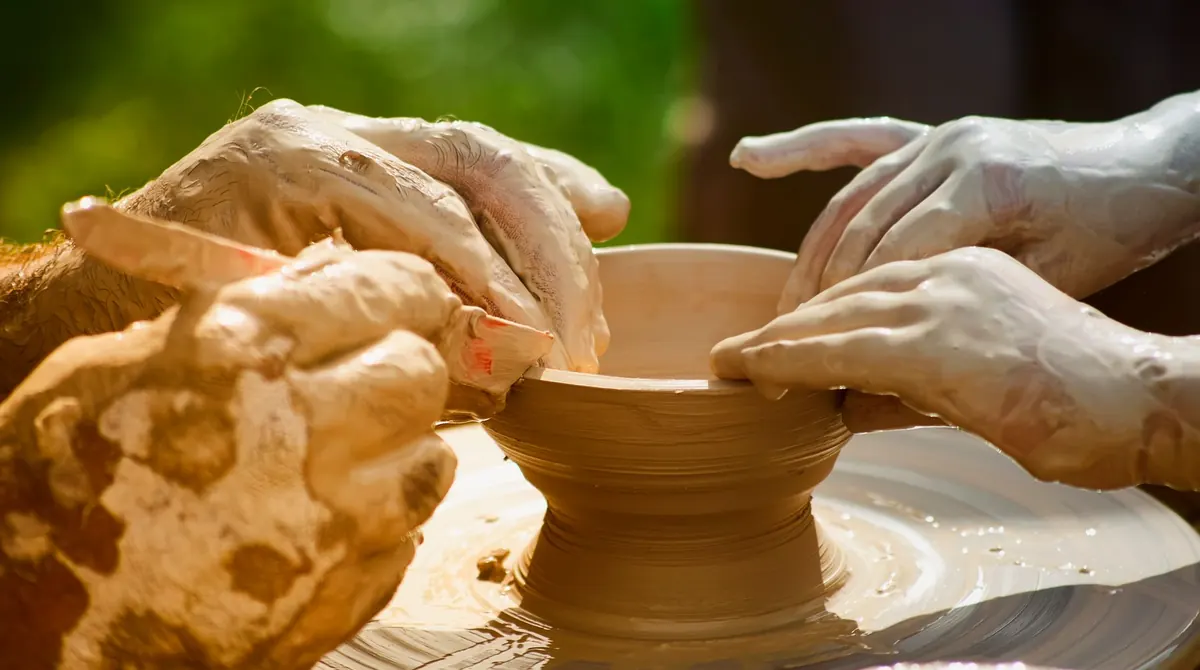
There is a moment every potter remembers: clay spinning out of control under your hands, a shape almost forming, then collapsing into a grey pancake. What happens next depends largely on whether someone is standing beside you to say "slow the wheel down and keep your elbows in". That is the honest difference between taking a class and teaching yourself. Both routes produce good potters. They just cost you different things — money, time, or a stretch of stubborn trial and error.
What a structured class actually gives you
A good class compresses the early learning curve. Centring clay on a wheel is a physical skill, and screens are poor at teaching it: you cannot see pressure, only results. A tutor watching your hands can correct your posture, your wheel speed and your water in the first session, saving weeks of repeating the same mistake without knowing why.
Then there is the kit. Classes come with wheels, a kiln, glazes, tools and somewhere to make a mess that is not your kitchen table. That matters more than beginners expect, because the equipment you cannot improvise — a kiln above all — decides what you are actually able to finish.
Finally, classes give you a deadline and a room full of people doing the same thing. Watching a classmate's glaze come out metallic when they expected matt teaches you something a video cannot.
In the UK, most beginners find classes through local authority adult learning services, further education colleges, arts centres, community studios run by working potters, or teaching potters who advertise short courses. Term lengths vary widely, so read the small print.
Questions worth asking before you pay
- How many students are there per tutor, and how many wheels?
- Is clay included, and is there a firing charge? Ask whether firing is billed by weight, by shelf space, or as a flat fee.
- Do you keep everything you make, and how long does work take to come back from the kiln?
- How much of each session is hands-on teaching rather than watching?
- Is there open studio time for students between sessions?
The self-teaching route, and where it bites
Online tutorials have become genuinely good. For hand-building — pinching, coiling, slab work — a careful beginner with a bag of clay, a board, a rolling pin and a couple of wooden guides can get a long way on free videos and library books. Surface decoration is similar: sgraffito, slip trailing and underglaze painting are all learnable at the kitchen table.
Wheel throwing is harder to learn alone, for the reason above: it is a feel skill. A tutorial can show you the sequence of moves, but it cannot tell you that your clay is too soft, that your wheel is running too fast, or that you are bracing your hands against your own body instead of the wheel head.
The real bottleneck is firing. You can make greenware anywhere. Firing needs a kiln, ventilation, and some understanding of what happens at temperature. Some studios and community kilns will fire work for a fee if you ask, which is often the cheapest way in.
Dust: the one serious thing to get right
Clay is safe to handle wet. The risk comes from dry silica dust — sweeping, sanding, emptying a bin. Mop floors rather than sweeping them, sand outdoors or with proper extraction and a suitable mask, and keep clay-dusted clothes out of living spaces. If you have a respiratory condition, speak to your GP before setting up a workshop at home.
Studio access: the option beginners forget
Between classes and going it alone sits open-access studio membership. These are studios, often run by working potters, that rent bench or wheel time by the hour, session or month, with a technician around and kilns you can book. Some ask for an induction or evidence that you can work independently; a few run beginners' courses as a gateway.
For someone who has done a term of classes and can centre reasonably reliably, membership is often the best value in pottery. You pay for access rather than tuition, you work at your own pace, and there is a technician to ask when something goes wrong. It also keeps you attached to a kiln, which is what home potters most often lack.
Costs vary a lot by region and by what is included — clay, glaze, firing, storage — so compare the realistic monthly total rather than the headline rate.
Which route suits you
- Choose a class if you want the quickest start on the wheel, you like working alongside other people, and you can commit to a weekly session for a term.
- Choose self-teaching if you want to start cheaply, you are drawn to hand-building and surface decoration, and you already have a route to a kiln.
- Choose studio membership if you have the basics, want regular wheel time, and learn best by making your own mistakes.
Plenty of potters mix all three: a short course in the autumn, a monthly studio membership, and tutorials at home when a specific problem comes up. Nothing says you have to pick a side.
A practical way to begin
Pick one goal for the next three months rather than "learn pottery". Good examples: centre half a kilo of clay without fighting it; make six mugs that match; glaze a set of tiles so you know what your glazes do at your firing temperature. A goal like that tells you whether you need teaching, kit, or simply more hours.
If you are starting from nothing, a short course of six to ten weeks is usually money well spent, even if you later work alone. After that, weigh up a studio membership against the cost of firing your work elsewhere.
When you search, use plain terms: pottery classes plus your town, adult learning plus your county, open access pottery studio, kiln hire. Visit before you commit and look at the kiln area, the glaze shelves and the state of the wheels.
Keep a notebook from day one: clay body, where it came from, how it was fired, which glaze went where, and what you thought of the result. Beginners lose more progress to forgotten variables than to lack of talent.
The potters who improve fastest are rarely the ones with the best equipment. They are the ones making something twice a week and looking closely at whatever comes out of the kiln — and asking for help the moment they get stuck.
Photo: igovar igovar / Pexels